
The Dangerous Habit of Trying to Beat the Train
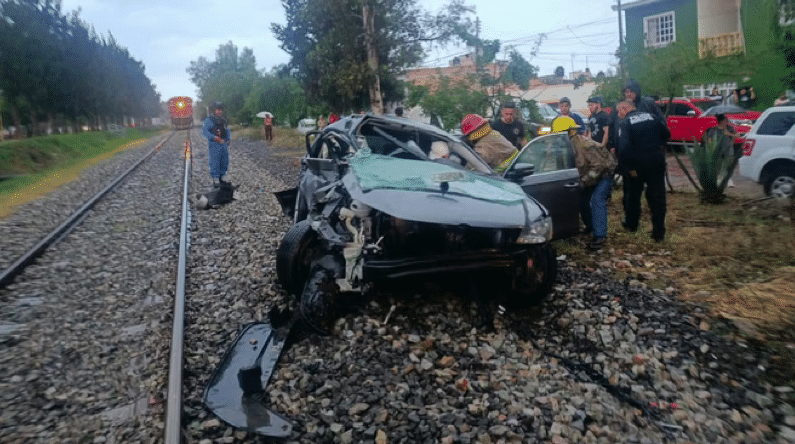
There is a phrase that appears far too often in reports of railroad accidents in Mexico: “The driver tried to beat the train across the tracks.” It is neither an innocent expression nor a euphemism. It describes a split-second decision that, time and again, ends in tragedy.
Another devastating accident occurred in Pabellón de Arteaga. On Tuesday, October 27, shortly before 6 p.m., a train struck a car at the intersection of Irrigación and Ignacio Zaragoza streets, in the Carboneras neighborhood, dragging it several yards down the tracks. Two children were killed, while the woman driving and another child were seriously injured. Authorities are investigating the circumstances of the crash, and it would be irresponsible to draw conclusions before the investigation is complete. What we do know is that two young lives were lost and a family was forever changed by an irreparable tragedy.
The numbers confirm that these are not isolated incidents. Between 2020 and 2025, Mexico’s Integrated Rail and Public Transportation Agency (ATTRAPI) recorded 7,969 railway operational safety reports. Of those, 4,316—approximately 54.16%—involved incidents at railroad crossings, where tracks intersect with streets or highways. This category includes different types of incidents and should not be confused exclusively with collisions between trains and motor vehicles. In 2025 alone, the agency recorded 727 incidents at these crossings.
The Mexican Association of Railroads, which represents companies in the industry, maintains that many of these incidents could have been prevented through defensive driving and compliance with safety measures. That is a valid point, but it also raises questions about the conditions under which drivers must navigate these crossings.
In the municipality of Aguascalientes, between 2017 and October 2026, the Municipal Public Security Department recorded 90 train-related accidents and 27 fatalities. The scale of the problem is clear: roughly one accident every five or six weeks over that period. And those figures cover only the state capital. The risks are also present in Pabellón de Arteaga, Rincón de Romos, San Francisco de los Romo, and other communities crossed by railroad tracks.
What is troubling is not only how frequently these accidents occur, but also how normalized this dangerous behavior has become. Trying to beat the train has turned into an ingrained habit. People do it because they are in a hurry, because they are overconfident, because they have crossed safely before, because the train’s horn sounds far away, or because they assume the engineer will be able to stop. They fail to understand—or choose to ignore—that a freight train may need hundreds of yards to come to a complete stop. It cannot swerve out of the way. It cannot react like a car.
But individual recklessness is only part of the problem. Blaming everything on drivers leaves fundamental questions unanswered: How many railroad crossings have safety gates? How many have working warning lights and adequate signage? Who makes sure these systems function properly? And who is held accountable when they fail?
Railroad infrastructure must also be subject to scrutiny. It is not enough to demand caution from drivers without ensuring that the places where roads and tracks intersect meet appropriate safety standards. This does not mean that an infrastructure failure caused the accident in Pabellón de Arteaga; determining its causes is the responsibility of the investigating authorities. It means recognizing that prevention requires shared responsibility among motorists, railroad operators, and the relevant government agencies.
Road safety education deserves the same scrutiny. Obeying traffic signs is essential, but so is understanding that a train’s physical characteristics make sudden evasive maneuvers or immediate braking impossible. That knowledge should be part of sustained public awareness campaigns, particularly in communities where railroad crossings are part of everyday life.
Mexico needs accurate information about where these incidents occur, what causes them, and what measures are being taken to prevent them. Publishing statistics regularly is necessary, but so are assessments of crossing conditions and compliance with maintenance and oversight requirements. Data should be used to identify and address risks, not merely to count tragedies.
Concrete action is needed: safety gates and warning systems at high-risk crossings, verifiable maintenance of existing equipment, publicly available information on safety conditions, ongoing education campaigns, and effective penalties for those who fail to meet their obligations. Prevention must involve both those behind the wheel and those responsible for operating and overseeing railroad infrastructure.
The deaths of two children in Pabellón de Arteaga demand a thorough investigation, but they also call for a broader reflection that goes beyond this particular case. We cannot grow accustomed to treating every railroad accident as a news story that lasts a few hours, only to wait for the next one.
As long as we continue to believe that “sometimes you can beat the train,” and as long as railroad crossing safety remains anything less than a permanent priority, the danger will persist.
The laws of physics are not negotiable. A train cannot stop in time.
Time will tell… and I welcome your thoughts.